
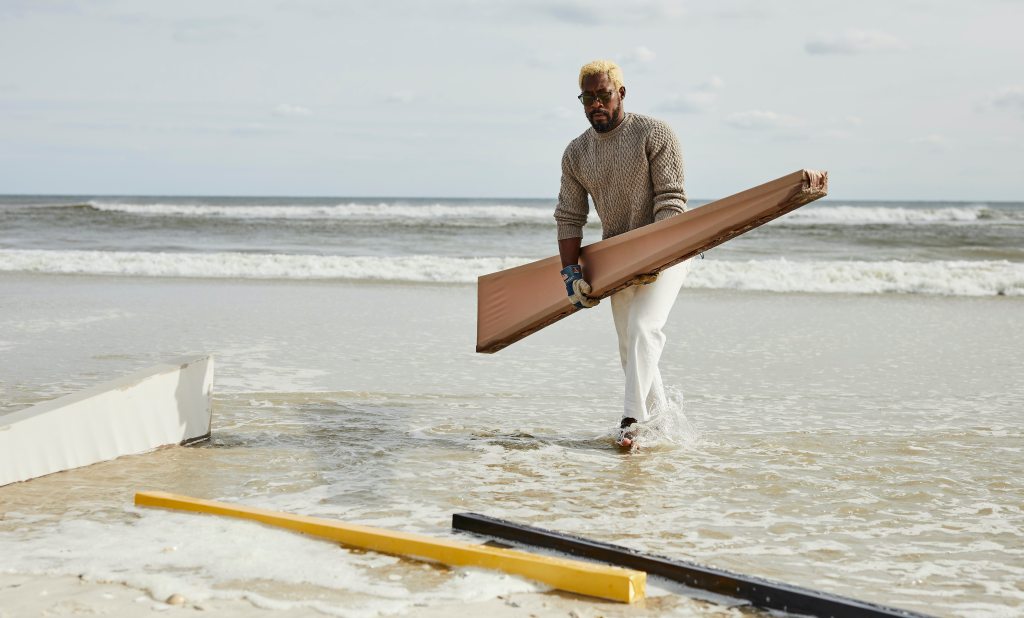

Rather than presenting raw earth as the art object, Perkins transforms nature into an art object in situ at his home and studio on Fire Island in New York. He refers to his works as “post-totem” structures, paintings and sculptures that conjure the ancestral spirit of his great grandmother’s Chickasaw tradition, and go further to reference totemic symbols of power—the coded behaviors we adopt to navigate systems of identity, society, and capital in the United States. Through his practice, he situates himself in a unique methodology for art making that merges the philosophies of Land Artists like Michael Heizer, Robert Irwin, and James Turrell, with the sensibilities of minimalist painters like Ad Reinhardt, Agnes Martin, and Mark Rothko. Though these artists allowed Perkins to comprehend the limitlessness of material and form, his work depicts a contemporary politic beyond these movements, which centered white men at the epoch of American industrialization.
Instead he activates this history to contemplate how abstraction can invoke a society that is postmodern, post-race, and post-gender, using land to invite a harmonic, inclusive vision of the future.
When embarking on a piece, Perkins makes a 2×4 wood structure, meant to symbolize the human form, and wraps it in vibrant silks sourced from the Fashion District in New York City.
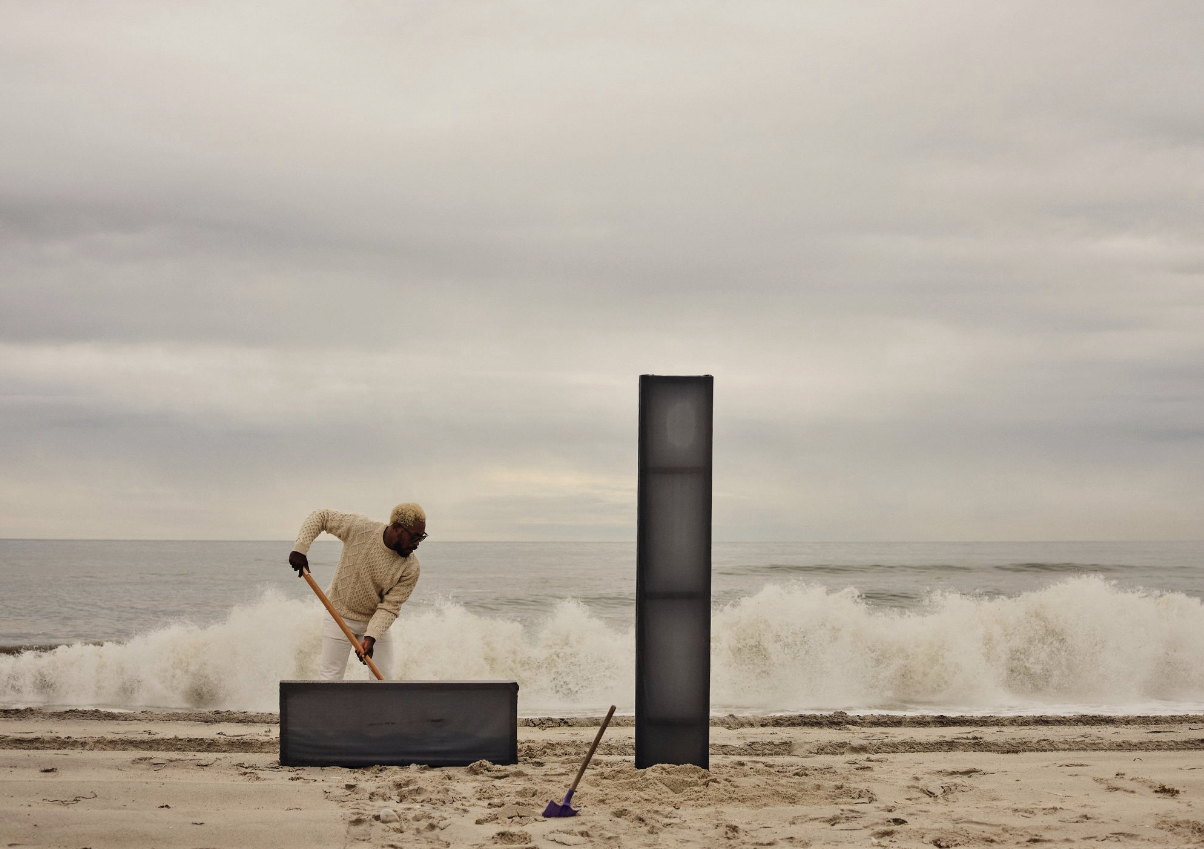
His palette is saturated, but always attune to seasonal pigments he encounters in nature. He buries these silk structures in his surrounding environment, leaving the textile to be worn, stained, and weathered by the natural elements. Curing the silks in open air for several months or years, he rotates and repositions the structures to encourage diverse oxidation and pattern. Though often placed without witnesses, Perkins’ process of burying his works is a durational performance. Once unearthed, the silks are then detached and stretched onto triangular and rectangular armatures, revealing fossilized striations and delicate discoloration. The work produces no waste and causes no disruption to the surrounding environment—peacefully co-existing with the elements. Once the work is complete, the earth continues on with its biological rhythms and cycles.
Perkins’ post-totem structures are monumentally elegant in appearance, yet the artist’s process is acutely critical of society’s inclination to establish hierarchies of value that divide us from the natural world, and each other. Through an idiosyncratic exploration of material culture, art history, personal experience, and philosophical prompts, Perkins reshapes land art to suggest a more vulnerable and generous approach toward the world around us. In many ways, Perkins makes this work equally in reverence and refutation of the white-centric masculine egotism of Land Art and Minimalism in search of an art for all humanity.
Through his Post-Totem Structures, Perkins seeks to contribute to a history of philosophies, inspired by the ideals of Dansaekhwa masters, like Lee Ufan, wabi-sabi, land and earth art, Transcendentalism and Romanticism, combined with the ethos of environmentalism. Perkins’ new type of “painting” system in nature where the sculpture and the painting happen simultaneously ask us to question form, identity, process, and our relationship with the land. Additionally, Perkins expands the definition of a work’s life cycle, by considering Walter De Maria’s desire for viewer duration, see Lightning Field, with Robert Smithson’s “non-site” nomenclature.


Leave a comment