
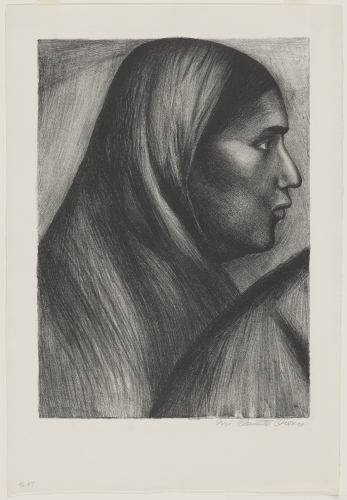
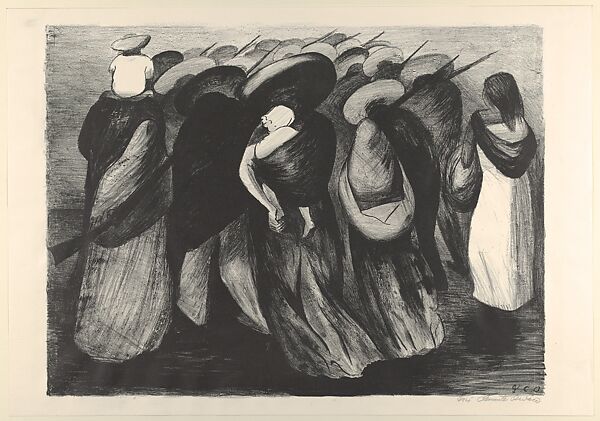
Together with Diego Rivera and David Alfaro Siqueiros, Orozco was one of Mexico’s three most influential muralists. The most dedicated printmaker of the three “giants,” Orozco completed some thirty lithographs and twenty intaglios during his career, printing etchings in his own studio This print comes from a series of lithographs that Orozco created based on his 1926 mural at the National Preparatory School in Mexico City. Men, women, and children—some of whom carry rifles—probably represent civilian soldiers who fought in the revolution. Women soldiers (soldaderas) played an integral part in the battles and participated in all factions. The composition, with the figures clustered together and viewed from behind, emphasizes their group identity and collective effort.
José Clemente Orozco’s impact on printmaking was significant, contributing to the Mexican print renaissance alongside other muralists by creating powerful, expressionistic lithographies that communicated nationalist and social themes. His work was both politically charged, as seen in prints for the popular press, and focused on artistic merit for elite audiences, with his prints gaining him national attention in the U.S. during his time there.
Between 1927 and 1934, Orozco lived in the United States. Even after the stock market crash in 1929, his works were still in demand. From March to June 1930, at the invitation of the Pomona College Art Department, he painted what he noted was the “first fresco painted outside the country by a painter of the Contemporary Mexican School”. The fresco, Prometheus (Prometeo del Pomona College), on the wall of Pomona’s Frary Dining Hall, was direct and personal at a time when murals were expected to be decorous and decorative and have been called the first “modern” fresco in the United States. Later that year, he painted murals at the New School for Social Research, New York City, now known as The New School. One of his most famous murals is The Epic of American Civilization at Dartmouth College, New Hampshire. It was painted between 1932 and 1934 and covers almost 300 square meters (3,200 sq ft) across 24 panels. Its parts include: Migrations, Human Sacrifices, The Appearance of Quetzalcoatl, Corn Culture, Anglo-America, Hispano-America, Science and Modern Migration of the Spirit (another version of Christ Destroys His Cross). His work was also part of the Art competitions at the 1932 Summer Olympics in Los Angeles.
Back in Mexico
After returning to Mexico, in 1934 Orozco painted a mural, The Catharsis, at the Palacio de Bellas Artes in Mexico City. Remaining in Mexico, Orozco painted in Guadalajara, Jalisco, the mural The People and Their False Leaders in the Government Palace. The frescos for the Hospicio Cabañas, which are considered his masterpiece. In 1940 he painted at the Gabino Ortiz Library in Jiquilpan, Michoacán. Between 1942 and 1944 Orozco painted for the Hospital de Jesús in Mexico City. Orozco’s 1948 Juárez Reborn huge portrait-mural was one of his last works.
In 1947, he illustrated the book The Pearl, by John Steinbeck.
While still residing in Mexico City, Orozco died in his sleep on September 7, 1949, aged 65. The cause of his death was heart failure.


Leave a comment