
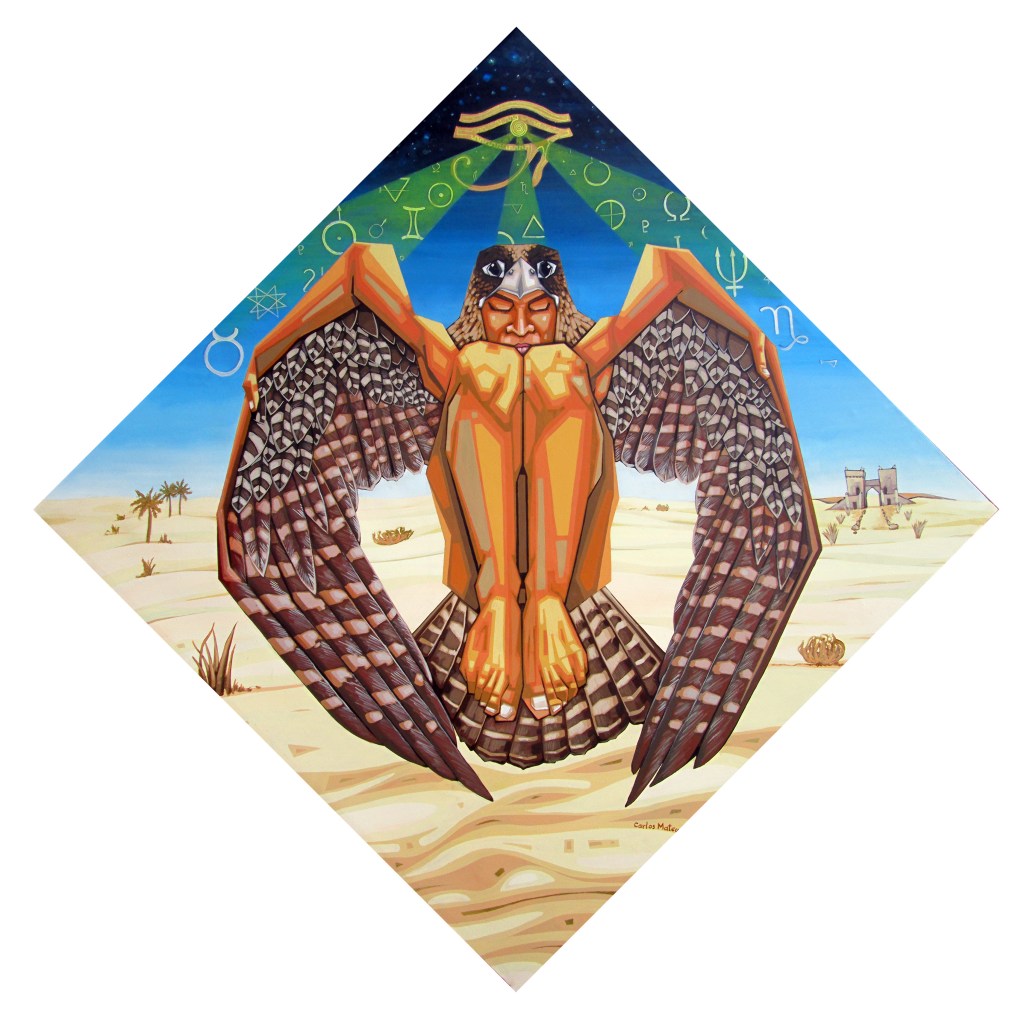
The West Harlem Art Fund is proud to presentCarlos Mateu for its fall exhibition on Governors Island in Nolan Park. Carlos Mateu’s paintings invite viewers into a symbolic world where geometry becomes a language for storytelling. His distinctive style, which he calls Pop Geometric, combines the structural discipline of Cubism with the clarity of Realism, while drawing on Surrealism, Symbolism, and Mysticism to explore time, memory, spirituality, and the human experience. Rather than illustrating ideas, his paintings encourage contemplation, revealing new meanings with each viewing.
The show will have a soft opening on Saturday, August 29th and a formal opening on Saturday, September 5th in Building 10B, running through November 7th.
Artist Bio
Carlos Mateu, born and raised in Havana, Cuba, has been inspired by a rich culture of art and music since childhood. He studied fine arts at the San Alejandro National Academy of Fine Art in Havana, and worked as an artist and designer of international exhibitions.
Since coming to the US in 1997, he has exhibited his art extensively, and also works as a graphic designer. He was commissioned to produce a series of murals, paintings and logos for schools, private business and various popular restaurants in NYC like Guantanamera, Toloache, Cuba, Café Cortadito, Havana ”Alma de Cuba,” and Agozár, etc.
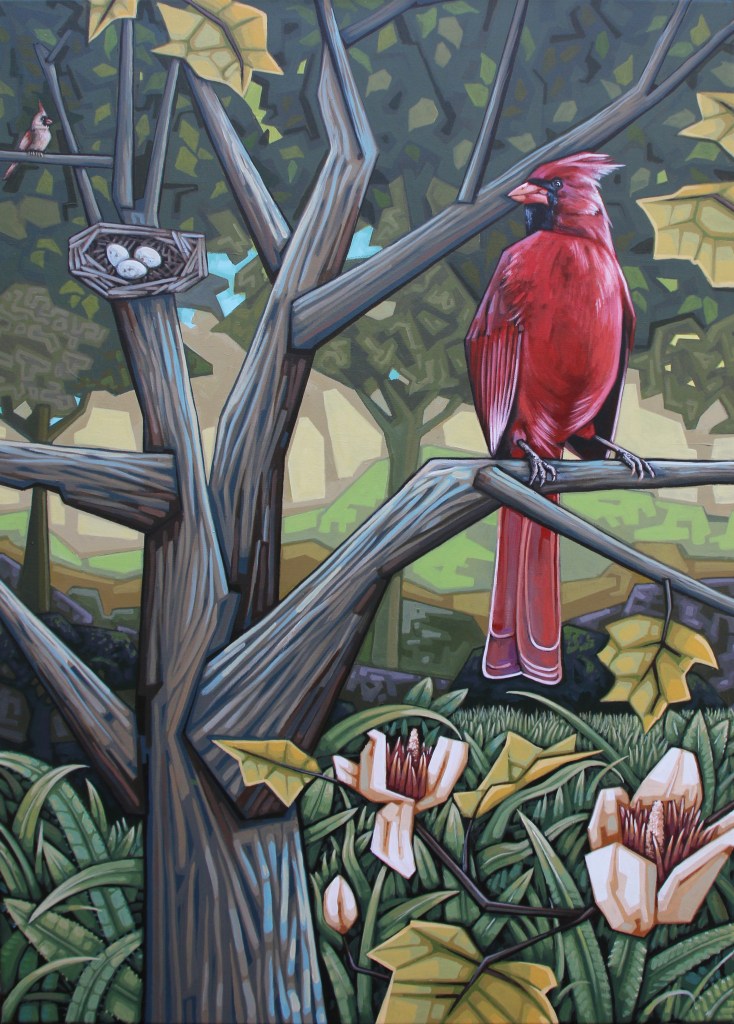
He calls his style geometric pop. His paintings fuse elements of cubism with realism, using straight lines and perspective to create a geometric and three-dimensional effect, while subtly deforming the images. Intense colors of acrylic are applied in layers like silkscreen, creating clean and precise divisions between tones, textured further with oil pastel. His subject matter incorporates surrealism and mysticism to reflect the Afro Cuban life and religions, memories of Cuba, his life in the United States and his own creative perspective on the world around him.
Although an artist-painter by trade, he grew up in Cuba in a vibrant musical atmosphere, surrounded by musicians and musicologists. His great grandfather was Obdulio Villa (nick named Pabellón), one of the most famous saxophonists of the 1920’s, who played worldwide with Moises Simon’s band, composer of the internationally known song “The Peanut Vendor.”
Dancing came hand in hand with this native musical education, which was a part of any and all social gatherings. Carlos learned to dance to traditional Cuban music (danzon, son, chachachá, etc.) from his Grandparents. Later he dedicated himself to the study of the theory and history of Cuban music, and participated in lectures, discussions, and performances held by UNEAC (National Union of Writers and Artists of Cuba) with leading musicologists such as Helio Orovio, author of the “Encyclopedia of Cuban Music”.
In NY, Carlos has danced with a number of local dance groups like Team Timba, lead by Karim Noak and companies like Areytos Performance Group led by Sita Frederick.


Leave a comment